My main takeaway from Chelsea this year was that I liked almost all of the gardens and I wish I didn’t. Sure, some I liked more than others, but no single garden genuinely shocked me, confused me, challenged me, or made me recoil slightly and mutter to myself, “what on Earth were they thinking there?” Everything felt broadly tasteful, broadly agreeable, broadly within the same aesthetic register. And I don’t believe I have the broadest of palates.
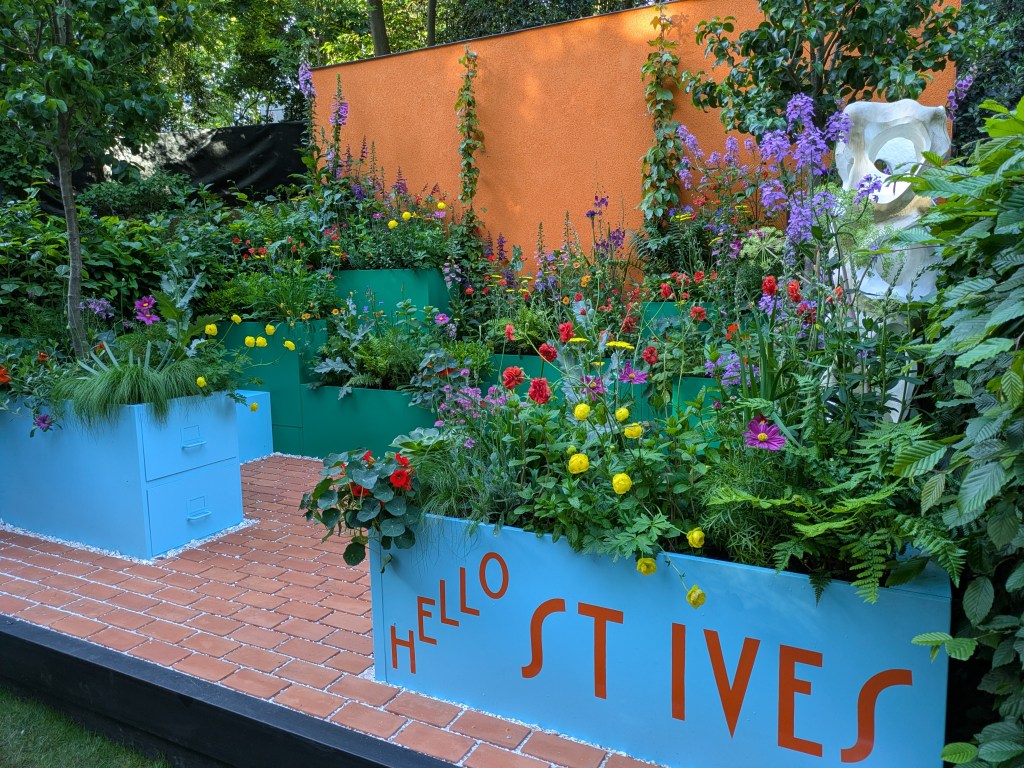
There was one garden that made me pause, tilt my head slightly, and think, “huh, that’s different.” It wasn’t even a show garden, but a container garden: The Seasalt Painted Garden, designed by Lynn James. The reason? It was a riot of bright colours. Filing cabinets repurposed as painted planters overflowing with flowers spanning the full spectrum. That’s it. On a scale of provocativeness it barely registered, but when nearly every other garden sits even lower on the scale, even modest eccentricity feels radical. Was it to my taste? Not particularly. Is that a problem? Not in the slightest. The problem is that almost everything else was to my taste.
What is the Chelsea Flower Show if not one of the great art exhibitions of the horticultural world? Designers clamour for the opportunity to showcase their abilities on Chelsea’s unparalleled stage. Floral artists create sumptuous displays on a grand scale. Plantspeople reveal cultivars they’ve spent years perfecting and months nurturing in order to bloom at exactly the right moment. Yet it’s all just so…nice.
There is an easily discernable formula to nearly all of the show gardens this year (and indeed for many years now):
- The largest eye-catching structure the plot can accommodate
- A generous entertaining space for sponsors and guests
- A water feature, preferably designed by the immensely talented Water Artisans
- Some enormous specimen trees
- Naturalistic perennial meadow planting
Discussion and critique from the sidelines then seems to nibble around the edges: “I’m not sure about that shade of ochre”, “pity that fountain only has one spout instead of three”, “that’s an incredibly tall iris”. That sort of thing. Nobody seems to be saying, “I’ve never seen a garden like that before,” or “what could the designer possibly have been thinking doing that?!”
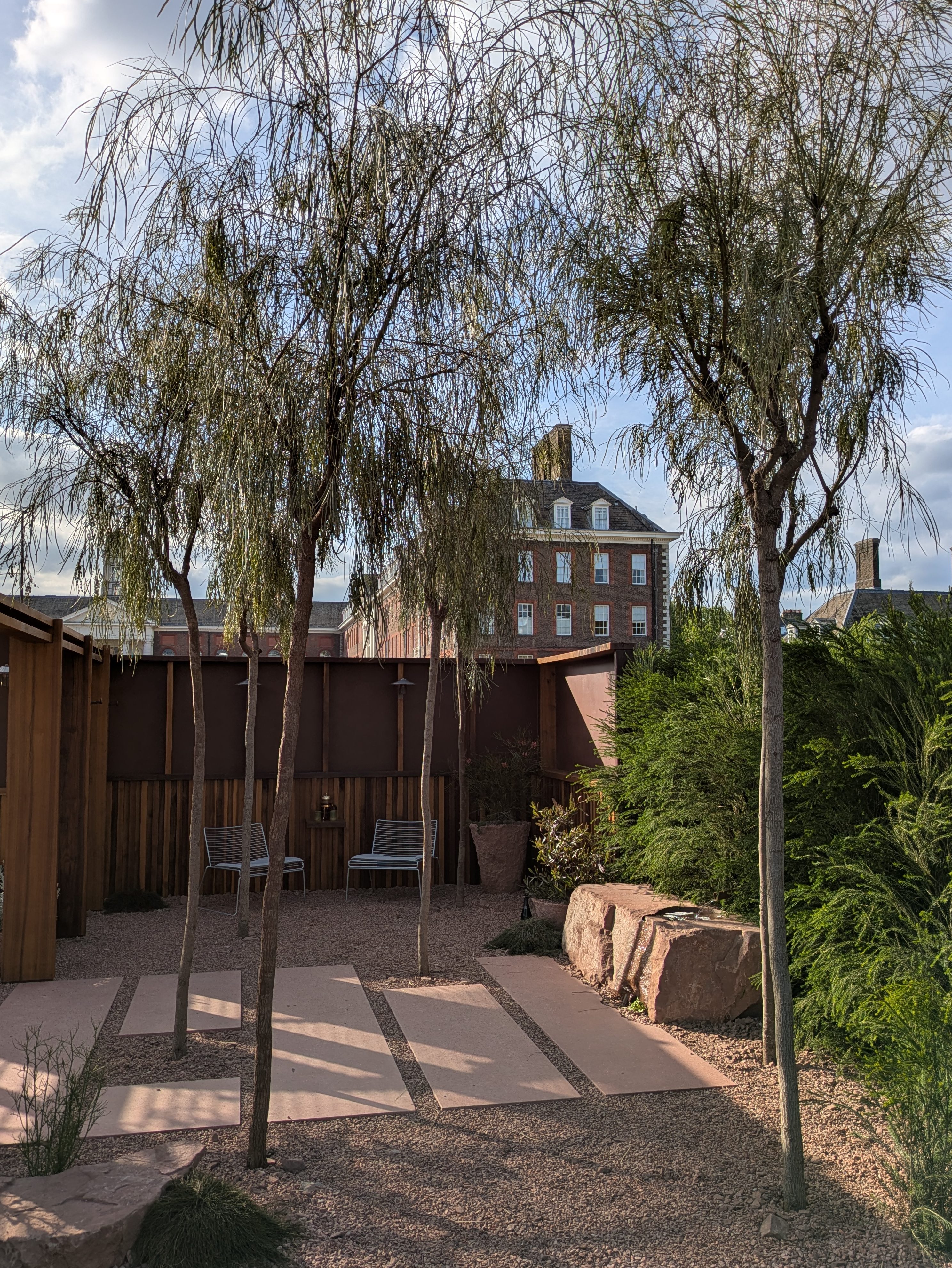
My favourite moment at the show came within one of the Small Show Gardens: Journey Beyond the Tracks: From Adelaide to Perth, designed by Max Parker-Smith. Not the garden as a whole, but a particular small space within it. A rather barren stand of Acacia stenophylla trees in a gravel courtyard beside the train-carriage-pergola-thing. I appreciated the restraint of it. The slight weirdness of the trees. The simple pair of chairs at the rear. The complete commitment to reddy-brownness. It felt otherworldly and atmospheric.
When I visit an art gallery, I don’t come close to liking all of the pieces on display. There are works I’m indifferent to; pieces that don’t make me feel much of anything. A few that completely stop me in my tracks; perhaps they’re technically astonishing, making me stare wondering, “how on Earth did they do that?” Or perhaps they capture some feeling that’s difficult to articulate. And then there are pieces that have the opposite effect entirely. Works that make me grimace or recoil or mutter, “why would anyone do that?”
That’s how it should be. Great art doesn’t try to cater to all tastes. The best doesn’t cater to taste at all. It pursues something more singular than that; an idea, a feeling, a provocation. Sometimes the result is beautiful to my eyes or sensibilities. Sometimes it isn’t. Chelsea, and other flower shows and garden festivals, increasingly feel to me like exhibitions in which almost every exhibit has passed through the same aesthetic filtering system before arriving on site.
I cannot stress enough that I don’t blame the designers for this. I don’t blame the RHS. I don’t believe there is blame to be laid at the door of any group or entity at all. I dealt a great deal with systems thinking in my previous career and there is no doubt that what we see at Chelsea is the outcome of numerous overlapping systems and incentives.
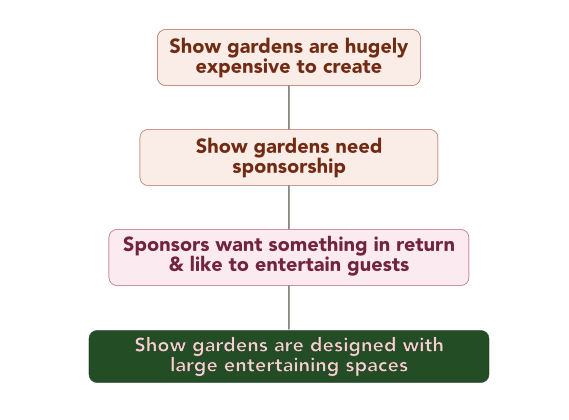
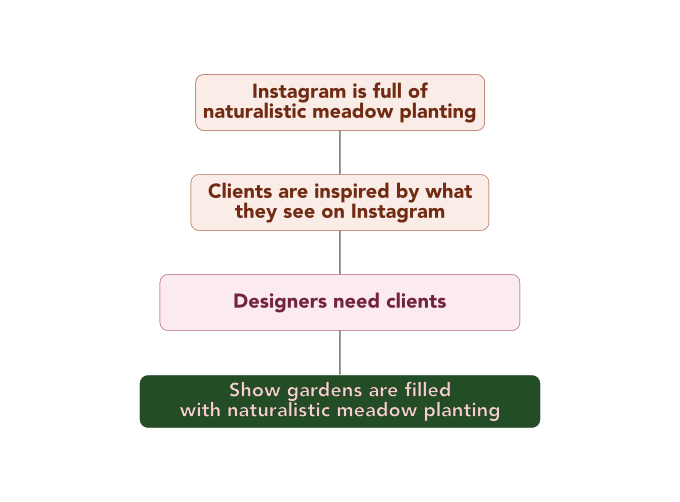
All of this is perfectly rational when the system has evolved in such as way that results in these outcomes. It is a pity though.
A pity that the systems surrounding Chelsea seem to funnel designers towards a relatively narrow set of visual and spatial outcomes. A pity that critics and audiences don’t seem particularly interested in being challenged or provoked at an event like Chelsea. A pity that if I were ever fortunate enough to design a show garden myself, I’d almost certainly find myself operating within precisely the same system.
I find myself wondering what the purpose of Chelsea is, particularly on the garden design front. Is it a reflection of the trends, aesthetics, and sensibilities of current times or does it set them? It feels currently that it’s the former. I wish it were the latter.


Good points.
LikeLike