Those who pay attention to these sorts of things will have noticed a not-so-quiet shift taking place in horticulture over recent years. Conversations that once centred almost entirely on aesthetics now include soil health, biodiversity, rewilding, and long-term resilience. “Sustainability” has become part of the design brief. I, however, find myself wondering whether we are still only looking at a small part of a much larger picture.
Before retraining as a garden designer, I spent several years working at the Ellen MacArthur Foundation on accelerating the transition to a circular economy. At its simplest, the circular economy is a system where materials never become waste and nature is regenerated.1 It is summarised in three principles: eliminate waste and pollution, circulate products and materials at their highest value, and regenerate nature.2
What strikes me now is that gardens have the potential to stand as near-perfect examples of circular economy thinking and yet this potential remains largely unrealised.
A particularly useful idea in circular economy thinking is the distinction between two types of material flows: biological and technical.3 Biological materials (plants, soil, timber, natural fibres) are part of living systems; growing, decaying, and returning safely to the earth. Technical materials (stone, brick, metals, plastics) do not break down in the same way or on the same timescales. They carry embodied energy and are most valuable when kept in use through reuse, repair, and adaptation.
The need to do things differently
The process of designing and building a garden typically follows a familiar pattern: sites are cleared, waste is taken away, and new materials are brought in. There may be gestures towards circularity – reclaimed paving, on-site composting, the reuse of aggregate – but the overall process remains fundamentally linear. The boundaries of the garden becomes the boundary of our thinking, and rarely do we consider how it participates in wider material and ecological flows.
There are, of course, pockets of good practice; designers and contractors who prioritise reuse, nurseries converting to peat-free systems, informal networks of plant and material exchange. But these tend to operate at the margins rather than shaping the system as a whole.
In the UK alone, the scale of this is significant. The horticulture sector has historically relied heavily on peat, with around 2–3 million cubic metres used annually in amateur gardening alone, despite peatlands being among the UK’s most important carbon stores.4 Garden plastics – from plant pots to packaging – run into hundreds of millions of units each year, with over 500 million plastic plant pots sold annually, many of which are not recycled.5 Even soil is often treated as disposable, stripped, transported, and replaced despite forming over centuries and underpinning entire ecosystems.6 Taken together, these flows point to a system still largely built on extraction, consumption, and disposal.
Much of the current response focuses on reducing harm: using a little less, wasting a little less, specifying slightly better materials. These are important steps, but the circular economy asks a more ambitious question: how might our gardens actively create value? Not just minimising damage, but building soil, increasing biodiversity, circulating materials, and contributing positively to the systems they are part of.
Change is happening. The phasing-out of peat in horticulture has forced a rethink of growing media, exposing both the environmental cost of established practices and the complexity of replacing them. At the same time, projects like the Rewilding Britain Landscape garden at the RHS Chelsea Flower Show 2022 have challenged conventional ideas of what a garden should look and feel like, embracing a looser, more ecologically driven aesthetic that provoked both admiration and discomfort. A garden grounded fully in circular economy principles – addressing not just regeneration, but also waste and material flows – could be equally, if not more, provocative.
From isolation to connectivity
We tend to think of gardens as isolated spaces, enclosed by fences, walls, or hedges. Viewed through the lens of the circular economy, their role expands. Rather than contained spaces bounded by walls or fences, they begin to look like nodes within larger systems, with materials, nutrients, and water flowing through them.
In principle, gardens can strengthen biological cycles – building soil, supporting pollinators, and increasing biodiversity – and handle technical materials more intelligently, selecting for longevity, enabling reuse, and passing materials on rather than discarding them. In practice, these outcomes remain the exception rather than the rule. The capability is there, but it is far from the norm.
This participation extends beyond materials. A garden might produce food and thus, (in a small way) reduces reliance on external supply chains, it should champion composting and return nutrients to the soil, or it could be a site of exchange – of plants, produce, and knowledge – within a neighbourhood. In these ways, a garden might contribute to the wider systems of which it is a part, rather than standing isolated.
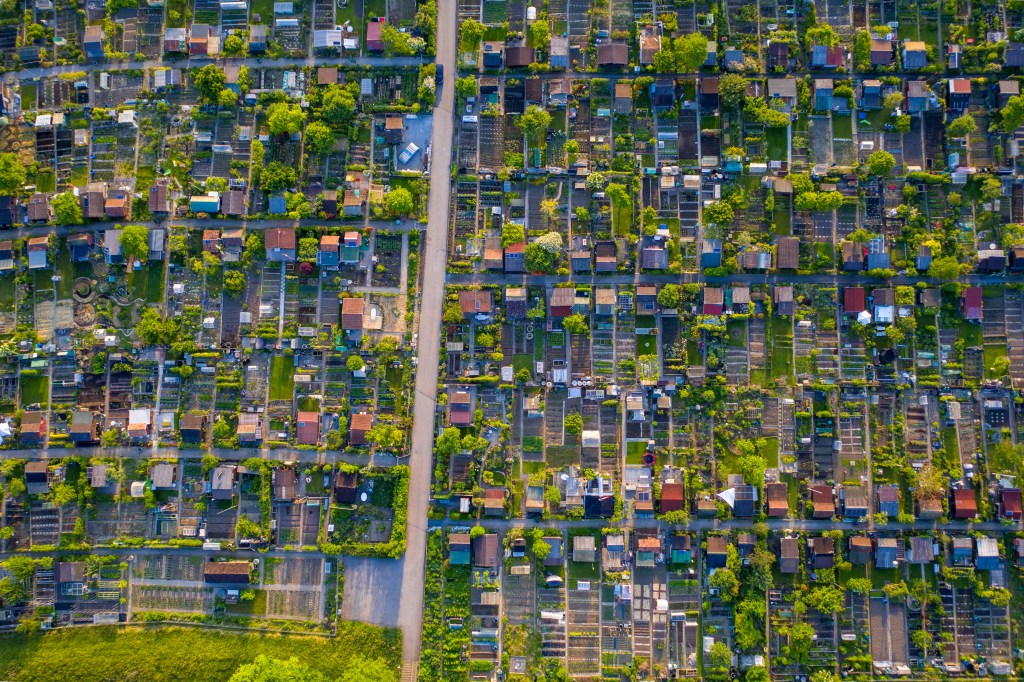
When it comes to biodiversity, interconnectivity matters more than isolation. Research into domestic gardens shows that no single garden needs to contain every habitat type to be ecologically valuable. The BUGS (Biodiversity in Urban Gardens in Sheffield) project recorded over 2,600 species of invertebrate across a sample of domestic gardens.7 More broadly, urban ecology research has shown that gardens collectively form a mosaic of habitats – lawns, ponds, perennial borders, trees – which together support a remarkable diversity of species.8 Ecological value emerges not just from what happens within a boundary, but from how those spaces connect across boundaries.
We need to design differently
Systems cannot be tightly controlled; they can only be influenced. A garden designed in line with circular principles is not a fixed outcome to be delivered and maintained, but is instead a set of conditions and interventions that shape how the system behaves over time. The role of the designer shifts from one of control to one of guidance; acting on the system, observing how it responds, and adapting accordingly (experienced gardeners will understand this role perfectly).
The shift that needs to be made is subtle but crucial. It is a move away from seeing the garden as an end product towards understanding it as part of an ongoing system. It is a move from asking how a garden looks and performs at a single point in time to asking how it functions – materially, ecologically, and socially – over the long term.
What would it look like to design a garden that actively eliminates waste from the outset? How might materials be kept in circulation beyond the boundary of a single site? And what does regeneration demand when treated not as an aspiration, but as a design principle?
Gardens already sit at the intersection of the biological and the technical. The question is not whether they have a role to play in a circular economy, but whether we are fully recognising that role and designing in a way that actively enables them to fulfil it.
Footnotes
- Ellen MacArthur Foundation, What is a circular economy? ↩︎
- Ellen MacArthur Foundation, The three principles of the circular economy ↩︎
- Ellen MacArthur Foundation, Biological and technical cycles framework ↩︎
- UK Government (DEFRA), Ending the use of peat in horticulture, 2022; Royal Horticultural Society peat policy briefings ↩︎
- Horticultural Trades Association, plastics and recycling estimates; UK Parliament ↩︎
- Food and Agriculture Organization, Status of the World’s Soil Resources ↩︎
- Smith, R.M. et al. (2006–2007), BUGS Project, University of Sheffield ↩︎
- Gaston, K.J. et al. (2013), Urban domestic gardens and biodiversity, Journal of Applied Ecology ↩︎
 Dale Walker